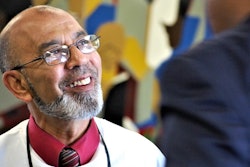
Meeting the Challenges Of ChangeTIAA-CREF’s BeRtram L. Scott discusses how the legendary financial institution responds to new environments in its quest to continue to help higher education professionals
By Frank L. Matthews
 In an era in which change is very much the norm, some would argue that a no-nonsense financial institution like TIAA-CREF changes at its peril. Not so, according to Bertram L. Scott, the executive vice president for product management at TIAA-CREF, one of the world’s largest retirement systems and leading providers of financial services to the education and research community.
Like any viable organization, TIAA-CREF’s success and that of its clients are very much tied to strategic growth and change. Their task of “fixing what is broken and not that which is not” is of great importance to the thousands of aging, as well as new higher education and research professionals.
Having weathered the criticism surrounding the compensation and governance issues of its chairman Herb Allison and that of companies in their portfolio, TIAA-CREF now must plot a successful strategy based on today’s economic and demographic realities.
Recently, Black Issues sat down with Scott, who oversees the company’s Product Management Group, which includes pensions, individual wealth management, individual protection, educational savings, institutional asset management and business development, to discuss how the company is changing to respond to their customers’ demands and changing needs.
BI: How would you characterize the financial sophistication of today’s higher education professionals?
BLS: My experience is that people in higher education, whether they are faculty or staff or administrators, are very interested in what is going on in their personal lives, about retirement. They have time to research, because the sheer nature of being on a college campus creates an environment to dig deeper than I think the average person does in investigating things. So we get very enlightened, very bright people who ask us some questions about what we do and how we do it. So I would say, without being arrogant but understanding the marketplace, that our constituency tends to be more informed than the general marketplace. That puts greater pressure on us to perform and to react when appropriate.
BI: What about those who may not be as sophisticated?
BLS: I think we have to serve them as well as those that are well informed. I think the way we go about putting together retirement plans, the range of investment options, the advice we give them, the fact that we have people who come to campus to talk to the administrators about the retirement plans, it sets us apart from everybody else. We are one of the only companies that serve those kinds of institutions, when you think about it. You don’t see our competitors on those campuses. We serve them because that’s our mission, whether you are a historically Black college or you are one of the Ivy Leaguers. It’s our mission to serve higher education. We never step away from that mission.
BI: How are the demographics of higher education professionals and the longevity of people in general driving the decision making?
BLS: First of all, we have customers who have been with us for a number of years, as you know. What we have to be mindful of is that the population on campus is aging. We are going to have a bubble of individuals who will be retiring, hopefully, in the next 10 to 20 years, which means that our payout phase will be increasing dramatically. We have to bring new people into this organization at the same clip as we have people starting to retire, or the franchise could be challenged. So we are spending lots of time focused on new entries, keeping our relationships with institutions in a way that we have not done before, talking about endowment plans and working with them in a much more robust way than we’ve ever done. If you think about higher education 85 years ago, we were really the only company that served them. Today, that’s not the case. You’ve got everyone trying to, particularly for those large institutions, clamoring for a piece of the market share. If we were still what I would say a monopolistic organization, we wouldn’t have to worry about the competition in the same way, or if we were retaining our market share in the same way, we wouldn’t have to worry. But the competition has found us, and we have to react to that.
BI: There was a lot out there about your social equity agenda and your historical, some would say, paternalistic role toward your clients and customers. Is your standing still intact?
BLS: I think it is. We still stand for treating people fairly and not benefiting by taking commissions and things like that to help people make clear decisions about their investment strategies. I think we stand in front of most of the marketplace in those areas, and I think that translates to a good social positioning for the marketplace that we serve.
BI: How do you communicate that? From what I see, there are still some anxieties out there as more people get closer to retirement. What is your time frame?
BLS: That is a great question. I think, first of all, time will take care of that. Actions speak much louder than words. We are still TIAA-CREF, and I think if you look at the way we’ve reorganized, our recommitment to the core of what we are, which is higher education faculty, you should be able to see that we’ve not really changed who we are. We’ve reduced expenses so that we can get a better return for our  participants, we’ve focused our business so that we are principally in higher education, K-12, which are the areas we have been in before. We’ve improved our client funding; we don’t take commissions. We’re developing an objective advice. We will be introducing third-party funds through our platforms so that people will say that TIAA-CREF is here to serve us, they have no hidden agenda. And I think that will just take time. People have perceptions, and if they see any evidence of that perception, they then take that and run with it.
BI: Do you feel as if you have kept pace with the competition in terms of flexibility and providing more funds and individual stocks, etc.?
BLS: I think for a while we did not keep pace, and what you’re seeing now in this organization is understanding that that has been the case, and we need to react to that very differently than we’ve done before. All of the changes we have made over the last 18 months or so are designed to be more nimble, to react faster to our clients, and to react to what they need in the marketplace perspective.
BI: Speaking of competitors, what is CREF’s biggest threat right now?
BLS: Not being well known by new people entering higher education, and not being positioned well enough to serve customers that are off on whatever market segment they happen to fall in, to serve them well. The biggest challenge for us is making sure that we get our fair share of all new entrants that enter a college campus, and that we are ready to adapt to the changes that happen on the college campus — new administrators, new professors, not all tenured, lots of adjuncts, some coming from private industry versus growing up in the education system, people who don’t have brand recognition of TIAA-CREF, and who have not had the benefit yet that some of the folks that retired, and retiring well, have seen.
BI: In terms of keeping the enterprise viable so that you can accomplish those goals, what new markets do you see CREF headed toward?
BLS: One thing that I want to remind us of is that we still have great opportunities in our core market. There is market share opportunity there, there is relationship-deepening opportunity there that I think we should focus on principally. There are natural businesses that we should expand to. We are introducing a new asset management business called TIAA-CREF Asset Management business, and that organization primarily focuses on the endowment community, the defined benefit community, to begin to help them manage those assets, particularly from mid-sized institutions.
The large institutions like Harvard and Yale, they do their own asset and endowment management. But for those mid-sized, upper-tier mid-sized institutions, we have an opportunity, given our relationship with higher education and our track record as very good investment managers, to help them manage those assets, also. We’re going to appeal to those institutions to see us as a firm that can help them with their endowment management or with their defined benefit plan, for both higher education and the commercial world.
BI: What about these pre-retirement medical savings type plans?
BLS: If you remember, we used to be in the health care business and we decided to get out of it a number of years ago. I think what we should be trying to do for higher education is helping them consult around those issues to help them understand the drivers of health care, to help them build solutions around health care increases, but we don’t want to be in the health care business per se. I would like to see us lobby in Washington for legislative relief so that people, when they are putting aside money for retirement, can set aside some portion of their retirement money specifically for health care. Now, you can’t do that in your retirement account right now, but if you could do that, that money could be on a pre-tax basis, set aside specifically for health care so that when they retire, they have enough money, hopefully, to fund their health care.
It’s a huge issue on the college campuses. It’s a huge issue because you can’t have a retirement plan if you lose your health care. The universities can’t afford to pay for health care, so you have a bit of a conundrum. We should be in a dialogue with them about how they might solve that conundrum, even if we are not in the health business, but because of our special relationship with higher education.
BI: What is the biggest lesson that you take from all of the compensation and governance issues that have surrounded the company over the past few years?
BLS: The thing that I would probably focus on the most is where we are in the organization and the position we hold in the financial services community. We have a tremendous reputation for integrity, for good corporate governance and for being advocates for good corporate governance, and that position has served us well. And the good thing about it is that we were doing it before it was popular.
BI: What prompted the reorganization of TIAA-CREF?
BLS: It was our customers, honestly. They had greater expectations of us, they wanted us to move faster, they wanted us to react to their needs a little faster, and we were not aligned properly to do that. By realigning the way we have, we have three businesses that can now really react nimbly to client expectations, market changes, so that’s really what drove us. If you talk with them (customers) now, we’re beginning to hear that most of them see the benefit of the reorganization.
BI: What can you personally point to that’s gone the way you anticipated since joining the company?
BLS: Well, let me point to several things. When I came here to run the life insurance company only, we had not introduced a new product probably in three years, and I was able to introduce three or four new products in my first 12 months here. So I have a good track record of being able to identify market needs and get those out the door. Term products were something we produced. But more importantly, in my new role, early evidence of our success in changing and building the right kinds of products or the right kind of platforms, is our recent winning of a management contract with Harvard. A year ago we would not have been in a position to win the Harvard business. We are in the process of building a new pension platform, an administrative platform for our customer base. Long overdue, and we’re doing it in record time. We started this project last September, and by July it was completed. That’s record time for this industry. We were able to take the potential of that new platform, with enough there, for Harvard to feel comfortable giving us their defined contributions, but also giving us their defined benefits business. So not only did we retain what we had, we expanded our relationship based upon what they see as our ability to deliver on that new platform.
We’re going to be introducing what we call “life cycle funds” to the marketplace, funds for those individuals that you talked about earlier that maybe are less sophisticated, where you could put your money in and we would have an automatic asset rebalancing based upon your time horizon for retirement. You pick the time horizon, 10 years out, 20 years out, 30 years out. We will then take your money, put it in the appropriate funds that underlie this overall fund, so that we can meet your retirement expectation without you doing a thing. Now that’s for the person who is not a sophisticated investor, who trusts TIAA-CREF. So that set of funds will be out. We’ll be introducing this new business in August.
So I think by this time next year, you and I will be sitting here and you should be able to look back and see great evidence that those products were launched properly, that new platform was launched properly, and our customers feel better about us as an organization.
© Copyright 2005 by DiverseEducation.com