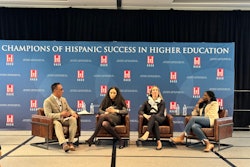
Conference Focuses on Improving Educational Opportunities For the Next Generation of Hispanics
White House Initiative conference stresses college preparation, parental involvement.
By Molly Nance
SANTA ANA, Calif.
When U.S. Treasurer Anna Escobedo Cabral visits Hispanic elementary school students across the nation, she deliberately chooses to speak with the kindergarten class first.
“I ask how many of them want to go to college. There is not one student who doesn’t raise their hand,” Cabral says. When she asks the high school students that same question, “I’m lucky if I get half of the hands to go up.”
Educators, community stakeholders and parents need to work together to ensure that the Hispanic community succeeds in higher education, Cabral said during her keynote address at the second regional conference of the Partnership for Hispanic Family Learning, a national public-private partnership focused on improving education for Hispanic Americans.
Co-sponsored by the White House Initiative on Educational Excellence for Hispanic Americans, the conference, held last month in Santa Ana, focused on engaging families in the effort to increase the educational attainment of Hispanic students.
Just as her own parents never expected her to go to college, Cabral says she identifies with first-generation Hispanic-American families whose only dream is that their children graduate from high school. But Cabral says the Hispanic community must guide the next generations towards higher education.
“We are the largest and fastest-growing minority. If we are not prepared, we can’t afford to lose half of our talent. We need to commit ourselves to improving the education of our children,” says Cabral, noting that aid from the federal government is limited to closing the achievement gap between Hispanics and non-Hispanics. “The federal government does not have the answers to these problems, there are stronger resources outside the federal government.”
he other speakers at the conference agreed that the earlier they start promoting education to Hispanic children and their families, the better. The speakers suggested that authorities raise standards for teachers, raise the graduation requirements for students and make reading and language acquisition their first priority under the federal No Child Left Behind law.
Lorena Amaya Dickerson, an education program specialist for the U.S. Department of Education, says it is imperative that the states continue to test their students’ progress.
“If we don’t test, we don’t know the level of English proficiency, and appropriate services cannot be determined,” she says. “If we don’t provide support for children to learn English, they will not be able to access the curriculum, and we won’t know when children are having difficulties and falling behind. We will then be unable to tell parents what their children can do and what they are able to accomplish.”
Dickerson also urged Hispanic parents who are not proficient in English to request that information about their child’s progress be provided in their native language.
Non-English speakers have a right under the law to request translations, but many don’t know about it.
“Having the knowledge about options and opportunities, and the tools to help [parents] navigate the education system, will go far in enabling more parents and families to make informed decisions about their children’s education,” said Adam Chavarria, executive director of the White House Initiative. He praised parent outreach programs that are working to close the information gap, and by extension, improve the educational outcomes of children.
The more the parents are involved with their child’s education, the more successful the Hispanic community will be in closing the achievement gap, says Rosa Harrizon, a student services specialist from Padres Promotores de la Educaciòn. Through the program, administered by Santa Ana College, parent promoters link the parents of middle school and high school students with services and information about college.
“We reach out to those parents who don’t think they have to be involved with their child’s education,” Harrizon says. She says she and 40 volunteers have to tread carefully during home visits to encourage parents to learn more about their child’s college potential because they often find themselves in a situation that involves domestic violence and abuse. “We have to be humble,” she says.
As the parent promoters stress to Hispanic parents the importance of their older children excelling in school, advocates say there should also be a strong emphasis on providing education for children entering pre-school. Only 10 percent of the pre-school programs in Orange County, Calif., for instance, provide accredited teachers, ample playgrounds and field trip opportunities for the children, says Dr. Juan Carlos Araque, vice president of community investments for the Orange County United Way.
“We want to replicate these programs for the future. We have 700 state-licensed child care facilities in the county, but not all of them are accredited,” he says.
To encourage parental involvement, an updated version of the Tool Kit for Hispanic Families was distributed at the conference and is now available from the Education Department. The tool kit, aimed at Hispanic parents and children, illustrates in English and in Spanish how to succeed in school and prepare for higher education.
© Copyright 2005 by DiverseEducation.com