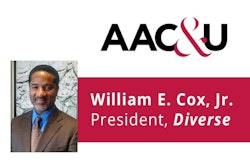
As the president of Howard University, I am often called on to
reflect upon Howard’s unique legacy. Recently, I was privileged to
address this legacy anew as we celebrated the life of Dr. James Madison
Nabrit Jr., Howard’s second African American president who passed at
the age of ninety-seven on December 27, 1997.
As I sat in Rankin Chapel beside great civil rights advocates —
Vernon Jordan and Jack Greenberg — and higher education leaders —
Walter Massey, president of Morehouse College, President Nabrit’s alma
mater: Dr. James Cheek, president emeritus of Howard, and Dr. Michael
Winston, president of the Alfred Harcourt Foundation — I once again
realized that perhaps my most important role is to bear witness, to
make real the legacy of civil rights warriors like President Nabrit and
those who served with him in the struggle — Charles Houston, William
H. Hastie, justice Thurgood Marshall, and George E.C. Hayes.
I welcome this responsibility as I am a beneficiary of the Nabrit
Legacy. I characterize myself as such because I attended undergraduate
school and law school at Howard under President Nabrit. Therefore, I am
doubly thankful for his leadership. It seems as if it was only a few
years ago when I attended my first freshman convocation. In those days,
the entire first-year class assembled every Wednesday for programs
sponsored by the president.
The first convocation featured remarks by President Nabrit. This
was just our third day on campus and we were all assembled in Cramton
Auditorium. I was seated in the upper reaches of the auditorium, as
became my custom, with my roommate. And, as is often the case with
first-year students, we were busily engaged in conversation about what
we were going to be doing that afternoon, that evening, and the next
day — hardly paying attention to the proceedings that were taking
place on stage. As a voice announced, “First-year students, the
president of Howard University, James Madison Nabrit Jr.” And we said,
“The president is here!”
President Nabrit strode to the microphone and said, “Ladies and
gentlemen, I want to welcome you to the capstone of Negro education.”
I said, “Hallelujah!” and we, the Nabrit freshmen, were off and running for the next four years.
That was in 1961, only seven years after President Nabrit’s success
in Brown v. Board of Education. Many more battles were still to be
fought in courtrooms all over America and in the Supreme Court and
Congress. But a great victory had been won and here we were, just
first-year undergraduate students, in the presence of one of this
nation’s history makers.
Seated two rows below me at that first convocation was Fred Banks,
now justice of the Supreme Court of Mississippi. In 1961, the
likelihood that a Black man would be on the Supreme Court of
Mississippi was no likelihood at all.
Elaine Jones, now director-counsel of the NAACP Legal Defense and
Education Fund, Inc., was also there. As was Togo West, now secretary
of the Army.
Some of us might have expected President Nabrit to talk about what
he and his colleagues had already accomplished. Instead, President
Nabrit, in his own inimical style and manner, spoke to us not about the
past, but about the future and our responsibility to help shape it. He
spoke with wit, passion, and intellect. And we all listened. Some not
only listened, but took his message to heart.
We freshmen weren’t the only beneficiaries of President Nabrit’s
legacy. There were those who began their education at Howard under
President Mordicai Wyatt Johnson and, like Michael Winston, finished
under President Nabrit. They continue to keep President Nabrit’s vision
alive and vibrant today.
And there are those who helped the Nabrit beneficiaries along the
way. How rich the Nabrit undergraduates truly were, seasoned with
intellectual giants like Frank Snowden, Sterling Brown, E. Franklin
Frazier, Rayford Logan, and so many others.
During the Nabrit years, the School of Law continued to be the
“West Point of the Civil Rights Movement,” with Clarence Clyde Ferguson
as dean, and Professors Herbert O. Reid, Frank Reeves, Julian Dugas,
Patricia Roberts Harris, Luke C. Moore, Newton Pacht, Charles Duncan,
and others. We studied the works of giants and my generation took to
heart the notion that Howard is a special place with a special mission.
Alice Gresham-Bullock, the current dean of the School of Law, and her
colleagues continue to honor that mission today.
As Michael Winston said at President Nabrit’s home-going:
“[President Nabrit] was an American hero…. With a brilliant mind
propelled by a clear purpose, he helped to change the history of this
country. Witty, generous, a prince of a man who was engaging to all —
high and low — he inspired us all with his tough-minded, fearless view
of the possibilities of a new society in the United States.”
Clearly, all Americans are his beneficiaries.
COPYRIGHT 1998 Cox, Matthews & Associates
© Copyright 2005 by DiverseEducation.com