Technology enables an historically Black medical college to serve poor Los Angelenos at greatly reduced costs
Sean Morris’s eyes worry him; they hurt sometimes and he wonders
what to do about it. A friend’s report of a six-month wait for exams at
the county hospital had discouraged him from seeking help. But
recently, the twenty-four-year-old discovered the Carmelitos
Teleopthalmology Center only a short walk from his home.
Morris calls to make an appointment and, to his surprise, is
scheduled for the next day. After filling out the necessary paperwork
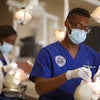
on the day of his visit, medical assistant Denise Kelly, leads him into
the examination room and introduces him to a young ophthalmology
resident from Drew University, Dr. Michelle Banks. Banks first takes
several pictures of Morris’s eyes from varying angles using a
computerized retinal camera. This digital camera is connected by a
cable to a computer, and Morris is amazed to see his eyeballs floating
instantaneously onto the computer screen. Thanks to this innovation,
testing him for glaucoma won’t require the traditional dilation with
numbing eye drops.
Also viewing the digitized images of Morris’s eyes is Dr.
Yadavinder Dang — an ophthalmologist sitting at his computer five
miles away at the King-Drew Medical Center. Banks and Dang discuss
Morris’s eyes; Morris can see and hear Dr. Dang on the screen, and the
doctor is able to study this patient thoroughly without even being in
the room.
While a high percentage of new patients arrive at Carmelitos with
serious eye problems, Morris gets a clean bill of health. His condition
is diagnosed as “dry eye” — nothing a little vial of artificial tears
can’t remedy.
Big-city public hospitals can be antiseptic, anonymous, and
anything but userfriendly — particularly if you are an uninsured
patient without easy access to preventive treatment. Recognizing that
the Black and Latino population in their county service area of 1.4
million Angelenos is already woefully underserved by existing
facilities, two African American ophthalmologists have almost
single-handedly launched the nation’s first urban telemedicine program.
Using leading-edge technology that includes videoconferencing,
online computers, and advanced software, thirty-four-year-old Dr.
Charles J. Flowers Jr. and forty-five-year-old Dr. Richard S. Baker
co-direct a new telemedicine program at the Carmelitos Housing
Development, the largest housing development in Los Angeles. However,
thanks to the new advances in information technology, they can do their
directing from a distance.
Flowers and Baker work from their base at the King-Drew Medical
Center and Charles R. Drew University of Medicine and Science, located
in the Watts/Willowbrook area of Los Angeles. They communicate in real
time with an on-site physician and two medical assistants, who examine
Carmelitos residents like Shawn.
“Sixty percent of the population coming in already have disease,”
says Baker. “Forty percent need serious treatment, and 7 percent are
already blind in one eye.”
The Carmelitos clinic, situated in the housing project’s community
center, is the first of five such locations scheduled to go online
within the next few months. One test site already operational is the
Grace Four Transitional Home, a private care facility located on a
quiet lowers residential street, where developmentally disabled
residents can videoconference with clinical psychologist Dr. Joan
Cooper, over at King-Drew. Since the program’s inception in October
1996, five doctors have been trained at the center.
While telemedical technology may strike some as intimidating, the learning curve for physicians is minimal.
“Doctors with only basic computing skills can be trained in a
couple of hours,’ says the program’s information specialist, Ian
Denchesy — who points out that it took Dr. Joan Cooper, a clinical
psychologist, only about forty-five minutes before she was functional.
“I am totally unwashed,” says Cooper. “This program is really a
testament to the human spirit, that you can do anything when the
technology is good and you have good people to work with.”
According to Denchesy, who is the Management Information Systems
(MIS) director for Drew’s Research Centers in Minority Institutions
(RCMI), a program funded by the National Institutes of Health, “Once
completed, King-Drew will have the world’s most comprehensive
telemedicine network, serving an estimated 4,000 to 5,000 patients
throughout Los Angeles County in 1999.”
And Baker points out, “In the first year we were up and running, we
saw more patients than 70 to 80 percent of all other telemedicine
programs that had gone before us.”
Space-Age Technology
Telemedicine, the ability to work on a patient while being
physically removed from that patient through high-tech virtual
treatment, has been around since the early 1960s. The National
Aeronautic and Space Administration first developed the concept so that
doctors could consult astronauts thousands of miles away in space.
Currently, it is used almost exclusively in rural areas and prisons as
a way to minimize healthcare costs.
Additionally, foreign doctors sometimes tap into U.S. expertise
through telemedicine links. The U.S. Army has a $30-million system in
place in Bosnia, according to The New York Times, which links “medical
staff there to physicians at military bases around the world.”
Determined to innovate, Flowers and Baker did what any pioneering
team must to prove just how serious they are about an untested program.
The doctors used their own credit cards, when necessary, to jump-start
urban telemedicine back in the fall of 1996. A year earlier, Flowers,
who is an avid reader of PC Magazine, realized that the technology
already existed.
Flowers and Baker completed initial developmental research and took
frequent trips together around the country to examine compatible
hardware and software. Baker drew on modest funds from his budget as
director of Drew’s RCMI to cover some communications expenses in the
early stages, including the purchase of two computers.
Today, each telemedicine site — including the Martin Luther King
Eye Clinic, the Carmelitos Clinic, and Grace Four Transitional Home —
is outfitted with a standard Pentium personal computer (PC), a Vtel
SmartStation videoconferencing system, a Second Opinion Software
patient record system, Internet Explorer 4, Netmeeting, and Microsoft
Office Professional.
As part of their big-picture strategy, Flowers and Baker also head
Drew’s new urban informatics test bed — a laboratory in which new
information technology and medical examination processes are integrated.
“What we do,” Baker says, “is take technology and try different
approaches to see what works and what doesn’t to actually provide the
most bang for the buck in terms of economic feasibility.”
Physicians at urban hospitals around the country can testify to the
frequent bottlenecks that occur in waiting rooms which service
treatment facilities for uninsured and Medicaid/Medicare patients.
“In our setting, we just don’t have enough board-certified
physicians available to meet the heavy demand,” Baker says. “With
telemedicine coming in at a third of the cost, we can staff these
clinics and we can optimize the allocation of our primary resource,
which is manpower.”
One of the innovations arising from Drew’s urban informatics test
bed will be a new “telemedicine technician,” who will already have the
basic training of an allied health professional or medical assistant.
The technician will then get cross-trained in a variety of fields.
“So an ophthalmologist making six figures will be converted into
several technicians at a lower cost, creating more jobs,” Baker says.
But if such programs churn out telemedicine technicians and their
multiple deployment, might that not affect a specialist’s earning
potential?
“No,” Baker insists, “you’re optimizing resources and delivery. The
technicians with the right training and protocols can provide that
first tier of care. And your [boutique] ophthalmologist can expand his
market share by having a telemedical system in place. It’s a way for
doctors to go into areas where they hadn’t ventured before. And it’s a
way to lock in a referral source.”
Getting off the Ground
While the early stages of the urban telemedicine program may have
struck the Drew bean counters as a lose-lose situation, it has become
apparent to many in the medical establishment that lucrative
possibilities abound. The field already has its own advocacy group, the
American Telemedical Association (ATA) in Washington, D.C.
Additionally, the Telemedicine Research Center (TRC) in Portland,
Oregon, has set up a Web site called the “Telemedicine Information
Exchange,” which now averages approximately 50,000 hits a month.
“The Drew urban telemedicine program is the only such program in
the nation right now that is serving a specific inner-city network,”
says Glenn Wachter, research associate at TRC. “That makes them very
unique indeed.”
Telemedicine, however, has yet to receive across-the-board approval
from private and public insurers. Currently, teleradiology is one of
the few telemedicine specializations reimbursed by Medicare. As a
high-profile industry, it may be a few more years before telemedicine
sweeps the country.
“Telemedicine is developing slowly, and that’s as it should be,” says the ATA’s John Linkous.
Actually, it wasn’t until November 1997 that Flowers and Baker
published the first peer-review report on their ground-breaking
project, in Telemedicine Journal.
“Quite often,” notes Flowers with a bemused smile, “doctors in the
system have no idea what we’re doing. A lot of them find out about
these projects by reading [journalism] articles.”
The first major seed money for the project — a $49,000 grant —
came from the Los Angeles County Community Development Commission
(CDC). After nearly a year of successful patient treatment at
Carmelitos, CDC official Carlos Jackson decided Flowers and Baker could
use some help from Capitol Hill. Jackson engaged a lobbyist who drummed
up the support of Millendar-McDonald, one of the project’s most
ambitious fundraisers and the driving force behind bill H.R. 4274,
which is currently up for approval before the House Appropriations
Subcommittee on Labor, Health, Human Services, and Education. The bill,
which seems likely to pass, includes a $1 million grant for Drew’s
urban telemedicine program.
“We are looking into other major health areas which telemedicine
can address -including hypertension, diabetes, lupus, and leukemia,”
says Millendar-McDonald. “The bill has been sent to the Senate side and
[Health Resources Services Administration Deputy Director] Tom Wolford
has promised to fund this project.”
Drew University, unfortunately, doesn’t have the deep pockets of a UCLA or a Cornell, Flowers’s alma mater.
“Our physicians have to go through a lot of challenges to prove
themselves, and we do our best to support them,” says Drew Vice
President for Advancement Robert I. Woods Jr.
Despite Drew’s $62 million annual budget, discretionary funds are
modest, and most of the university’s programs must be funded by outside
sources. Woods noted that a new strategic plan is in the works, however.
“I would expect that Dr. Flowers’s and Dr. Baker’s work will be
very much highlighted in the plan as a way to go,” Woods says. “The
president [Dr. Charles K. Francis] always speaks of it as one of the
highlights of the institution.”
Created partially in response to the 1965 Watts Rebellion, Drew
University is a postgraduate medical school that was founded in 1966
and named in honor of the brilliant Black physician, Dr. Charles R.
Drew (1904-1950). Drew became famous for his pioneering work in blood
preservation during World War II. Ironically, he bled to death from
injuries sustained in an auto accident when he was only forty-six years
old.
Often, notes Baker, people assume that proximity to a hospital
equates with easy access. But that is not necessarily so. As a county
official recently told Baker, a gunshot victim from one public housing
project, situated only two blocks away from the nearest medical
facility, barely made it in alive. That two-block radius happens to be
divvied up by three different gangs.
“Don’t ask me how,” Baker says, “but obviously if you go to that health center, you have to have a life-and-death situation.”
Culture Specific
Dr. Flowers is excited about where the urban telemedicine program
may go, in part, because it can be tailored to a precise cultural
population.
“Not only are you looking at a paradigm shift with respect to how
healthcare is being delivered,” he says, “but you’re looking at a
change in the culture. One of the things we saw as we went around the
country was that many of these sort of high-falutin’ telemedicine
systems were gathering dust because people weren’t using them. Not only
does telemedicine have to be doctor-friendly, it has to appeal to the
patient as well.”
Urban telemedicine can be “culture specific” because, adds Dr.
Baker, “you can deliver healthcare within the community of the
participant, rather than taking the person out of that community and
putting them in a foreign environment. If you have a largely Latino
environment, for instance, your site can be linguistically and
culturally Latino because some of the practices include both
alternative and traditional allopathic approaches.
Cooper, the clinical psychologist, appreciates this pioneering
program because the equipment “is not only going to allow me to have
direct service contact with some of these clients at the place where
they need intervention, but this will also enable mental healthcare
professionals to expand their knowledge and abilities to do a better
diagnostic on site and come up with a better treatment plan for people
with psychiatric disorders.
“I have been delivering mental health services to this special
population for nearly twenty years, and with the Department of Health
Services and then the L.A. County Health Services major crash back in
’95, we had a major gap. So this is really exciting now,” he adds.
Soon, Dr. Flowers says, federal, state, and private funding for
urban telemedicine will permit his team to expand into cardiology,
dermatology, and ENT (ear-nosethroat). And in addition to serving a
disadvantaged population, the program provides for leading-edge
education of young doctors.
“Our clinic at King is so backlogged, we work appointments four
months in advance,” says Banks, who commutes between King-Drew and
Carmelitos. “Here, I can do the examination while they observe me and
we can actually incorporate the patient into our dialogue. The program
has all the advantages of being at a university, right here in the
community.”
Jordan Elgrably is a freelance reporter who has written on culture
and society for such publications as the Los Angeles Times and The
Washington Post.
WANT MORE INFORMATION?
Contact: Telemedicine Information Exchange at
<www.telemed.org>; American Telemedicine Association at
<www.atmeda.org>; and/or Ian Denchesy of Drew University at
COPYRIGHT 1998 Cox, Matthews & Associates
© Copyright 2005 by DiverseEducation.com